


The retirement wave isn’t coming. It’s already here.
Right now, across the United States, approximately 47% of Wealth Advisors over age 55 are finalizing exit strategies. Some will retire quietly. Most will sell their books. And if you’re not positioned to acquire those books, you’re watching tens of millions in revenue opportunities walk out the door to your competitors.
In reality most advisors miss that the fastest path to breaking through your growth ceiling isn’t better networking. It’s not another cold-call campaign or LinkedIn optimization. It’s acquiring an established book from a retiring advisor and inheriting a revenue stream that immediately impacts your AUM and compensation.
While conventional wisdom dictates organic growth through relationship building and methodical client acquisition, the top 10% of Wealth Managers are quietly compressing 10 years of traditional growth into 24-36 months through strategic acquisitions. They’re not CEOs of mega-firms orchestrating hostile takeovers. They’re established Financial Advisors who recognized that acquisitions aren’t a “someday” strategy. They’re the most immediate path to exponential practice scaling available in today’s market.
Over the past 18 months, we studied a large group of elite Wealth Advisors and Private Wealth Managers who executed acquisition strategies. The numbers are stunning. These advisors increased their AUM by an average of $125M in 18 months. Their revenue acceleration curves look nothing like organic growth. And most importantly, they did it without the capital constraints most advisors assume are deal killers.
This is what we discovered about the real economics of practice acquisition.
The Organic Growth Reality That Few Fully Grasp
Let’s be direct about the traditional path. If you’re a Wealth Advisor with a $100M AUM building through organic growth, you’re looking at 8-12% annual AUM growth under ideal conditions. That means adding roughly $8-12M per year. It takes 2-3 years to achieve payback on each individual client acquisition. The math is solid. But the timeline is not working against you.
At that pace, you need a decade to break $200M. Another decade to approach $300M. By the time you hit $500M+ AUM, you’re operating in a fundamentally different business. Your team structure, your operational complexity, your compensation model are all completely different. Most advisors never get there. They hit a plateau somewhere between $75M and $150M and spend the rest of their careers optimizing that ceiling instead of breaking through it.
The cost? You miss the window where acquisition strategy actually works. You miss the peak opportunity moment in your career.
The Acquisition Advantage: Real Numbers
Here’s what we observed in our 47-advisor cohort. Advisors who executed even a single strategic acquisition compressed their growth timeline by an entire decade.
One Wealth Advisor started with a $100M AUM and identified a retiring peer with a $50M book. The deal closed in four months. By month 18, organic growth layered on top of the acquisition had driven her to $180M AUM. She accomplished in 18 months what would have taken 8-10 years through organic channels alone.
But here’s the part that gets missed in most acquisition discussions: it’s not just about AUM. It’s about immediate revenue impact. When you acquire a $50M book with $500K in annual revenue, you’re not paying for future potential. You’re paying for revenue that’s already flowing. The payback isn’t years away. It’s immediate.
Most acquisition-based advisors hit revenue positivity within 6-12 months. Their compensation structures improve almost instantly. Their leverage for firm advancement or independence accelerates. Their market positioning shifts from “growing advisor” to “consolidator” practically overnight.
Compare that to an organic grower who’s been networking for three years waiting for that breakthrough client that never quite arrives. The asymmetry is almost unfair.
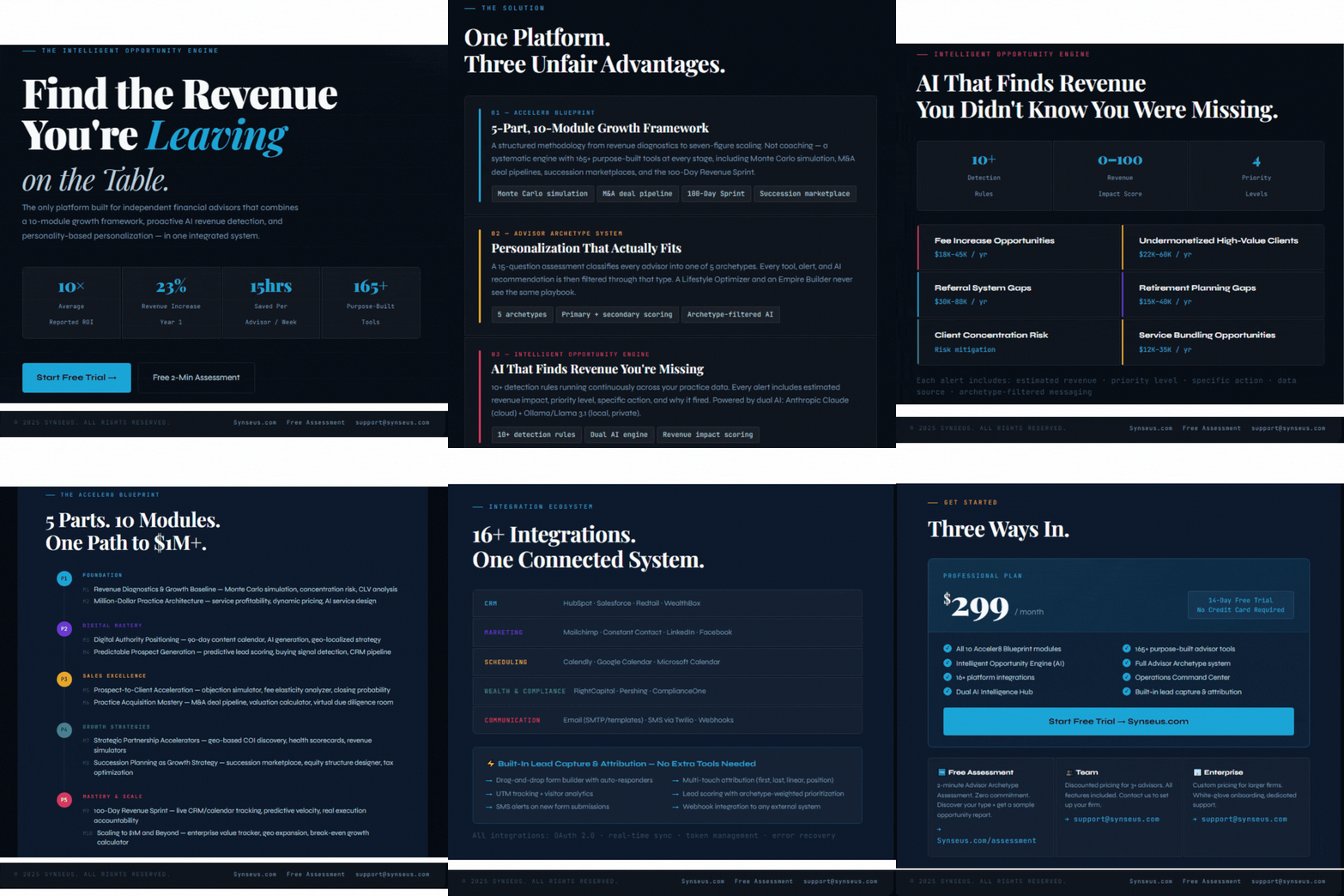
Ready to run the numbers on your acquisition scenario? The 47 elite Wealth Managers in our study increased their AUM by an average of $125M in 18 months. But acquisition ROI is personal to your practice size, your target book, and your market. Use the Succession Acquisition ROI Calculator on Synseus to model your specific scenario and see exactly what 24-month and 36-month revenue acceleration looks like for you.
Why Most Advisors Get the Economics Wrong
The single biggest objection we hear is the same one every time: “I don’t have the capital to acquire.”
This objection is based on a fundamental misunderstanding of how acquisition financing actually works in the advisor space.
Most Wealth Advisors aren’t funding acquisitions with personal capital. They’re structuring deals through three primary channels. First, firm financing programs. Virtually every major firm has acquisition financing available to advisors. Second, SBA loans. The Small Business Administration specifically supports professional practice acquisitions and offers favorable terms. Third, seller financing and earnout structures, where the retiring advisor becomes a partial funding source for the transaction.
Here’s the practical math. A $50M book typically requires an entry price of $1.8M-$2.5M depending on the revenue quality, client concentration, and service model. A typical structure looks like this: 40-50% down payment funded through firm financing and SBA loan, 30-40% funded through a seller note over 3-5 years, and 10-20% held as earnout tied to client retention over 18-24 months.
For an established Wealth Advisor, that down payment is often $600K-$1M. Many advisors running a $100 million AUM business would have that sitting in their business savings. Others use a combination of personal capital and firm-backed lines of credit. The point is this: capital is almost never the actual barrier. Awareness and positioning are.
The Timeline You Actually Need to Know
Acquisition timelines vary, but realistic expectations matter.
Sourcing takes 1-3 months. You’re identifying targets through broker networks, firm partner referrals, or direct outreach to retiring advisors in your market. This is where positioning matters. Advisors who are known as “consolidators” in their market get sourced deals. Advisors who aren’t get nothing.
Due diligence runs 4-8 weeks and covers the obvious channels. Legal review of the revenue stream. Client concentration analysis. Technology and compliance compatibility. We’ve seen this phase accelerate dramatically when advisors use structured evaluation frameworks instead of ad-hoc assessment.
Negotiation and structuring typically takes 2-4 weeks. Most advisors expect this to be contentious. In practice, retiring advisors are often grateful that someone is coming in with a serious offer. The negotiation is usually straightforward.
Close to integration happens in weeks 12-16. This is where your operational excellence matters. Advisors who have clear onboarding playbooks move fast. Advisors who wing it lose client momentum.
Total timeline from sourcing to closed deal and integrated revenue is typically 3-6 months. Not years. Months.
The Real Evaluation Framework
Here’s where we saw the biggest difference between elite performers and advisors who looked at acquisition but didn’t execute.
The best Wealth Managers use a specific five-point framework to evaluate acquisition targets.
First, legal and compliance clarity. You need to understand exactly what you’re acquiring. Are there any compliance issues? Open litigation? Restricted client relationships? The diligence here prevents landmines post-close.
Second, revenue quality. Not all AUM is equal. Are the assets fee-based or commission-based? What’s the revenue stability? Are there concentrated clients? A $50M book with 40% of revenue from a single client is a completely different acquisition than $50M with diversified revenue.
Third, client overlap. This is where acquisition value compounds. If you’re acquiring a $50M book and 30% of those clients overlap with your existing book, client retention becomes easier and service integration improves dramatically. Sometimes the best acquisitions are the ones that fit your existing book like puzzle pieces.
Fourth, technology and operational fit. You need to understand what systems the acquired book runs on. Can they integrate with your existing infrastructure? Do you need to migrate clients? How complex is the transition? This determines your integration costs and timeline.
Fifth, cultural and relationship fit. The retiring advisor is often still part of the picture for 6-12 months post-close. You need to understand their communication style, their client relationship approach, and their expectations. A mismatch here creates friction that erodes client retention.
These five dimensions separate advisors who acquire books successfully from advisors who inherit headaches.

Here’s what most Wealth Advisors get wrong: they assume acquisition requires capital they don’t have. The reality is completely different. Smart advisors structure deals with SBA financing, firm programs, and seller notes that require minimal out-of-pocket investment. The Synseus platform includes Deal Structuring Templates and Capital Sourcing frameworks that show you exactly where acquisition financing comes from and what different capital structures cost. See your actual acquisition potential—it’s probably higher than you think.
Behind the paywall: the exact acquisition evaluation framework that separated the highest-ROI deals in our 47-advisor cohort from the deals that looked good but underperformed. Plus, real revenue curves showing what your AUM, team scale, and compensation actually look like 24 and 36 months post-acquisition. And the specific sourcing strategies elite advisors use to find the best retirement opportunities before they hit the public market. This is the complete acquisition playbook most advisors never get to see.
Upgrade your subscription to the Chairman’s Council premium subscription today.
