

The advisors who cross $1M in revenue don’t work harder, they build differently. Here is the systems design framework separating the practice that plateaus from the one that compounds.

There is a version of this industry that looks like success but is indistinguishable from a trap. The advisor manages $80M. He bills 90 hours a month on client work. Revenue is strong, until he takes a week off and it isn’t. The pipeline depends on referrals he hasn’t formalized. The client experience exists inside his head. He is not running a practice. He is the practice.
This is the advisory equivalent of a load-bearing wall disguised as furniture. Pull it, and everything falls. And the bitter irony is that the harder he works, the more clients he impresses personally, the more relationships he maintains manually, the more weight he places on that wall.
The advisor who crosses a million dollars in sustainable, scalable revenue understands something structurally different: growth is not a function of effort. It is a function of architecture.
“The question is not how to grow faster. The question is whether your practice is designed to grow at all.”
What Architecture Actually Means
When engineers design systems meant to handle scale- software platforms, financial infrastructure, supply chains. They don’t optimize for the average load. They design for peak load, redundancy, and compounding throughput. They ask: what happens when this system is running ten times what it is today?
Most advisory practices are not designed with that question in mind. They are designed for the number of clients the advisor currently serves, the workflows that feel natural right now, and the informal processes that have never had to survive a stress test.
The Million-Practice Architecture applies engineering thinking to an advisory business. It breaks the firm into three domains — client experience infrastructure, operational systems, and growth mechanics. And demands that each be built to a standard that does not require the founder’s presence to function.
The three domains:
01 — Client Experience Infrastructure
02 — Operational Systems
03 — Growth Mechanics
None of these domains is new. Every advisor reading this is doing something in each of them. The question is not whether you have them, it is whether they are built, or merely improvised.
Domain One: Client Experience Infrastructure
The phrase “client experience” has been colonized by marketing language to the point of meaninglessness. Advisors talk about it as if it is a feeling- warmth, attentiveness, personal touch. These are outputs. Architecture is about inputs. The feeling your clients have is the downstream result of decisions you made or failed to make, about how your firm operates.
Scalable client experience is not warm and fuzzy. It is engineered. It means that every client, at every stage of the relationship, receives a consistent, high-quality interaction that does not depend on who is having a good week. It means the onboarding process is a documented system, not a performance. It means the annual review is a repeatable protocol, not an improvised conversation. It means that when a client calls at 4:45pm on a Friday, the answer they get is as good as the one they’d get on Tuesday morning.
The Touchpoint Inventory
The first exercise for any advisor serious about this domain is the touchpoint inventory: a complete map of every moment a client interacts with your practice, from initial inquiry through offboarding. Most advisors, when they do this honestly, discover three things. First, their formal touchpoints are far fewer than they believed. Second, their informal touchpoints, the unscheduled calls, the reactive emails, the off-the-cuff check-ins, are consuming enormous capacity. Third, the experience is different for different clients, which means it is not a system at all.
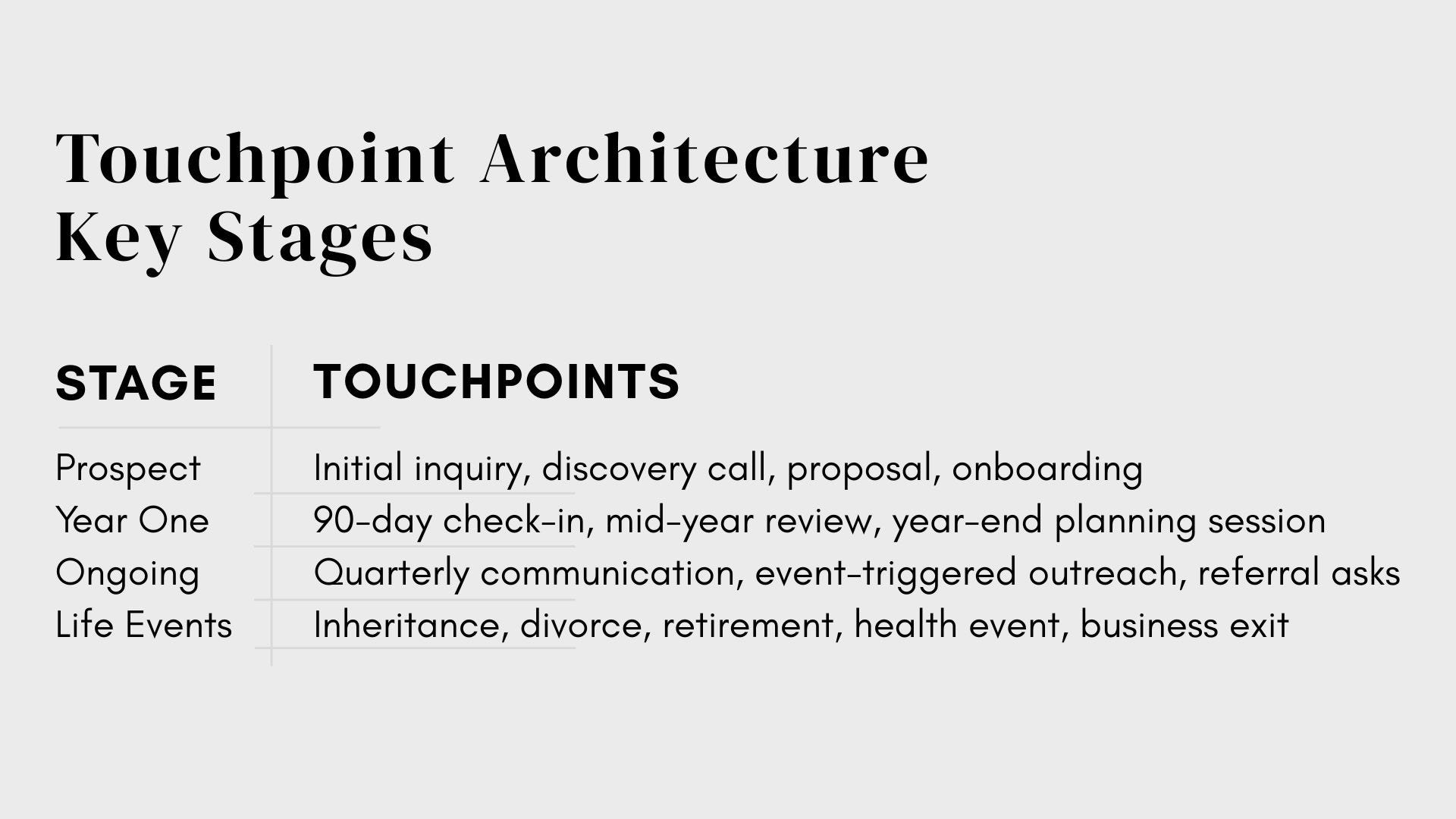
Once the inventory exists, the next question is candid: which of these touchpoints are genuinely high-value, and which are high-effort noise? The goal is not to do more, it is to build the interactions that actually deepen the relationship into scalable protocols, while eliminating the reactive, anxiety-driven contact that exhausts you and reassures no one.
The advisors building toward a million-dollar practice have learned to design the client journey the way a product designer designs a user experience: intentionally, from the outside in, with each touchpoint serving a specific function in the arc of the relationship.
💡 You’re reading a Chairman’s Council paid article.
What follows covers Operational Systems design, the Growth Mechanics engine, and the intelligence layer that ties all three domains together, including the exact metrics that predict which firms break through $1M and which ones stall. This analysis is exclusive to paid subscribers.
