


Forty percent of financial advisors over the age of 60 have no formal succession plan. Read that again. Nearly half of the advisors running the books that could transform your practice have not made a single structured decision about what happens next. According to Cerulli Associates, the industry is staring down a $2.4 trillion succession wave over the next decade, and the vast majority of that capital will transfer hands either chaotically or on someone else’s timeline. The advisors who quietly close the best deals are not waiting for listings. They are not refreshing broker marketplaces. They are already deep in a relationship while everyone else is still filling out an LOI.
Why Waiting for Listings Means Paying Full Price
Here is how the conventional process works. A Wealth Advisor decides it is time to exit. Their custodian refers them to a succession matching program, or they engage a broker, or the word gets out through the study group circuit. Within sixty days, there is a polished information memorandum, three to five buyers who have already been shown the deck, and a seller who has anchored on a number they read in a trade publication. What you are walking into at that point is not a negotiation. It is an auction with good manners.
The math on this is unambiguous. Listed practices in the current market are transacting at 2.0 to 2.5 times trailing revenue. Pre-market deals, sourced through relationships before a formal process begins, consistently close at 1.2 to 1.7 times revenue. On a practice generating $2 million in annual revenue, that spread is worth $600,000 to $1.6 million in deal savings. For most Wealth Managers, that is an entire year’s income sitting on the table simply because they arrived late.
The Pre-Market Premium: What Elite Advisors Actually Pay vs. What Everyone Else Pays
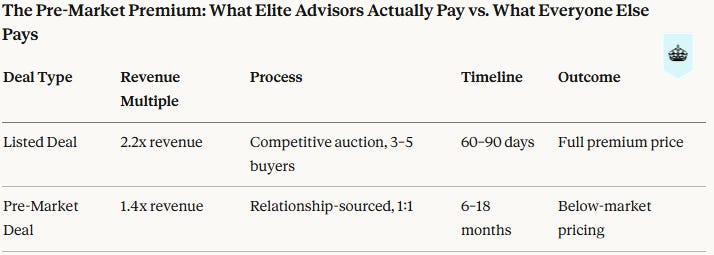
This is asymmetric thinking at its most practical. A 30% valuation discount is not a rounding error. It is a structural advantage that compounds on every deal you do. And the mechanism behind it is not genius — it is simply timing and relationship infrastructure.
RESOURCE
The advisors quietly closing pre-market succession deals are not operating on luck, they are running a system. The Succession Opportunity Identification tools breaks down the exact process for building your own pipeline of below-market acquisition targets 12 to 18 months before they list. Explore the Succession Planning tools at Synseus.com.
Introducing the Retirement Radar Framework
Elite Private Wealth Managers do not stumble into pre-market deals. They run a systematic, always-on intelligence framework that most people in this industry have never heard of, let alone implemented. Call it the Retirement Radar: a four-layer detection system that identifies transition-ready advisors before they have made a single phone call to a broker or a custodian succession program.
The framework has four active detection layers. Each layer operates simultaneously, and the signal gets exponentially stronger when two or more layers are lighting up on the same target at the same time.
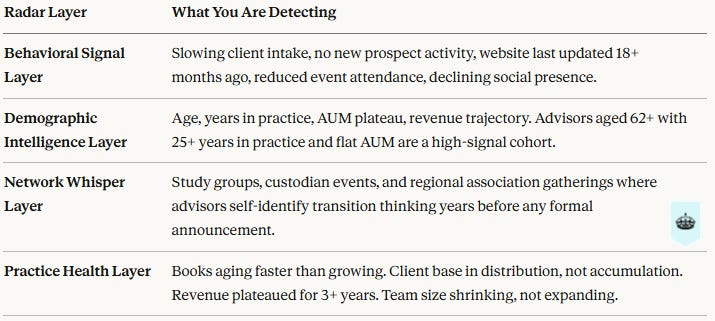
When you have an advisor who is 64, whose AUM has been flat for three to five years, who stopped attending the regional FPA chapter events, and whose last LinkedIn post was in 2022 about retiring a colleague? That is not a signal. That is a siren. The advisors running this framework actively and systematically have a pipeline of six to twelve pre-market targets at any given time. When one becomes ready to transact, they are already the trusted peer in the room — not the buyer who called out of nowhere.
🔒 The content below is available to paid subscribers. Upgrade to Chairman’s Council Premium to access the full implementation framework.
The Relationship-Building System That Yields Below-Market Deals
The single most expensive mistake a buyer makes in practice acquisition is showing up as a buyer too early. The advisors who consistently close pre-market deals at favorable terms spend the first 12 to 18 months of their approach never once mentioning acquisition. They enter every relationship as a peer, a collaborator, or a resource. The transaction conversation comes later, and when it does, it comes at the seller’s initiation far more often than most buyers realize.
The methodology runs on five tactical principles that experienced Wealth Advisors execute so naturally they rarely think of them as a system at all.
