

Most Wealth Advisors treat the calendar as a flat line. Elite performers treat it as a launch trajectory. The data on what actually separates the two will make you uncomfortable.
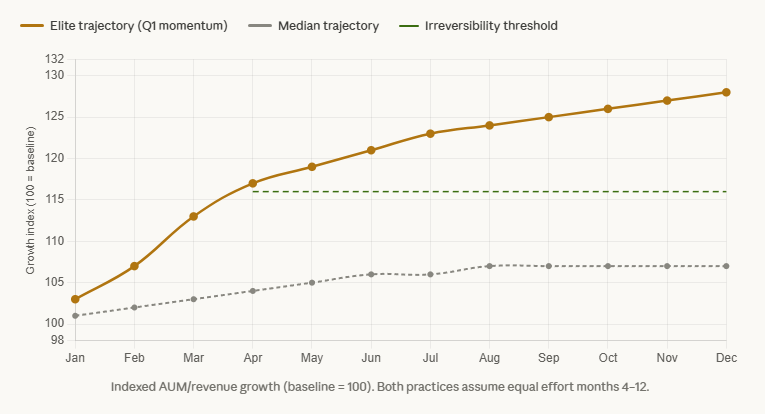
Chart 1: The Acceleration Gap Curve
Top-quartile Financial Advisors generate a disproportionate share of their annual growth differential in the first quarter alone, this, according to Cerulli Associates. Not by the end of June. Not by year-end. By April. The advisors who are ahead at the 100-day mark are not just winning a sprint. They are statistically unlikely to be overtaken for the remainder of the year. If you have been operating under the assumption that December results are determined by December effort, this article is going to be an uncomfortable Wednesday morning.
The “Acceleration Gap” Phenomenon: Why the First 100 Days Determine Your Next 3 Years
Welcome to the Acceleration Gap. It is not a motivational concept. It is a structural, measurable, compounding phenomenon that separates the top ten percent of Wealth Managers from everyone else, and it starts forming right now, whether you are manufacturing it deliberately or watching it open against you from the sidelines.
The Underground Research on Momentum and Trajectory
Behavioral economists Hengchen Dai, Katherine Milkman, and Jason Riis published research in 2014 establishing that humans attach disproportionate significance to what they call “temporal landmarks,” meaningful dates that function as psychological reset points. New years, new quarters, milestone birthdays. The research showed that goal-directed behavior spikes sharply at these landmarks, which explains why your January pipeline looks different from your October pipeline even when market conditions are identical.
Elite Wealth Managers have been quietly operationalizing this for years. While the median advisor is still onboarding their CRM updates and recovering from the holiday client gauntlet, a small cohort is manufacturing structural advantages that will calcify over the following ten months.
The mechanism is not psychological alone. It is mathematical. Momentum in a wealth management practice follows the same compounding logic as the asset class your clients are invested in. An early COI relationship activated in January has twelve months to generate referral velocity. A client review cycle established in Q1 positions you for a natural consolidation conversation before summer. A fee optimization implemented in February compounds into measurable ARR gains by December. These are not incremental advantages. They are flywheel effects that mid-year starters cannot replicate regardless of effort. McKinsey research on high-growth professional services practices consistently identifies early-year action density as one of the strongest predictors of annual revenue outcomes. The plane that reaches takeoff speed in the first third of the runway does not merely have a head start. It is already airborne while the competition is still calculating its acceleration.
Why Q1 Performance Compounds Dramatically
Let us be honest about the math, because Financial Advisors of all people should not need this explained and yet somehow the logic never gets applied to our own businesses.
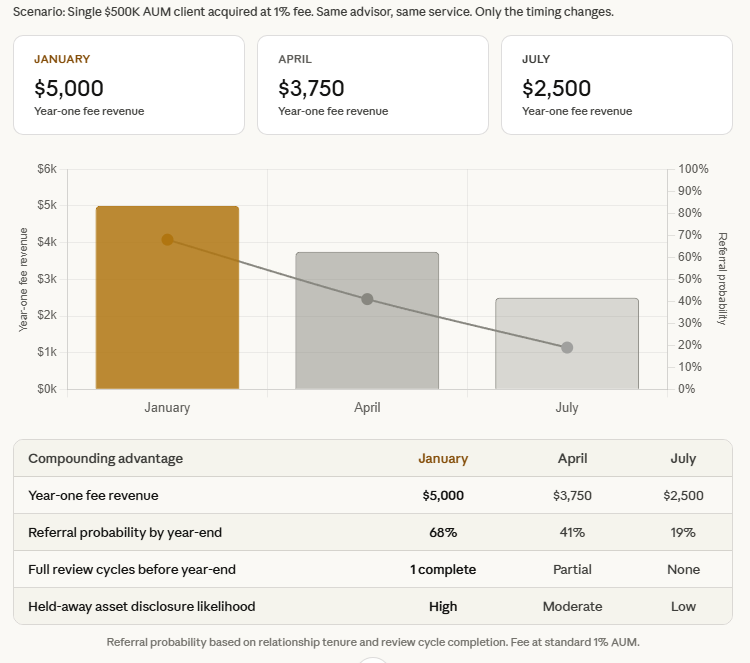
Consider two Wealth Advisors with identical books and identical skill sets. Advisor A lands two $500,000 AUM clients in January. Advisor B lands the same two clients in June. At a standard 1% AUM fee, Advisor A generates $10,000 in fees from those relationships before Advisor B even starts the clock. But the fee differential is actually the least significant part of the gap. Advisor A’s January clients have six additional months of relationship deepening, which means they are meaningfully more likely to provide referrals before year-end. They have completed a full annual review cycle, opening a natural conversation about consolidating additional held-away assets. They have six more months of experiencing Advisor A’s service model, which means their satisfaction scores are higher, their referral language is sharper, and their social proof value to prospects is fully developed. That is what compounding asymmetry looks like in practice: a small timing advantage producing a structurally larger outcome.
The industry’s conventional wisdom holds that great service wins over time regardless of when you start. That is technically true over a decade. It is functionally irrelevant within a calendar year. The data knows this. And here is the part that should genuinely sting: Financial Advisors understand compound interest better than almost anyone on the planet. We explain it to clients every week. We build entire retirement projections around it. And then we somehow fail to apply the same logic to our own business trajectories. That cognitive dissonance is not a personality flaw. It is the gap. And someone in your market is exploiting it right now.
Chart 2: The Compounding Math of Q1 Wins
Before you go further: If you can feel the Acceleration Gap opening in your practice right now, the diagnostic framework below will show you exactly where you stand. Pull up the 100-Day Revenue Sprint in the Advisor Tools at Synseus.com (Module 9) before you continue reading. Run the momentum mapping exercise on your current pipeline. What you find in the next ten minutes will make the rest of this article land with considerably more precision. The window on Q1 is closing. That is not rhetoric. That is the calendar.
The Psychological and Practical Acceleration Factors
(Full access for paid subscribers, upgrade to a paid subscription today and get 25% off on your first year of the Chairman’s Council)
