


Tax season isn’t about compliance. It’s about timing. Elite wealth managers often see through the blind spots that traditional advisors miss. Clients are anxious about taxes, motivated by documentation, and mentally primed for financial decisions. Yet most advisors miss this window entirely.
The reality in this industry is striking. Top tier practices that execute deliberate tax season strategies capture an average of $520K in incremental annual revenue by April 30th, while traditional practices generate their usual flat $180K to $220K. That’s a 240% revenue uplift from strategic timing alone.
The key insight separating the top 8% from everyone else: tax season isn’t about tax optimization (every advisor offers that). It’s about wealth restructuring conversations that only surface when clients are already thinking about money. That’s a severely disproportionate advantage.
Three Strategies Elite Advisors Execute Right Now
Strategy 1: The Tax Trigger Segmentation Model
Elite advisors don’t treat all clients the same in February. They segment into three buckets, each with a different conversation framework.
Bucket One: Liquid Surplus Clients received a tax bill larger than expected. They have cash and are thinking about money. Your opening: “Your tax bill tells me something important about your current structure. Can we spend 20 minutes understanding what it means for your wealth plan?”
Bucket Two: Illiquid Opportunity Clients hold concentrated positions or equity compensation. Tax season is when they’re reviewing these holdings. This is when tax-loss harvesting and diversification conversations feel natural.
Bucket Three: Succession-Triggered Clients are receiving inheritances, bonuses, or distributions. They’re thinking about receiving money and managing it simultaneously. Restructuring conversations feel organic here.
Revenue attribution: Your Liquid Surplus segment alone generates an average of $180K through bonus advisory fees and AUM capture.
Strategy 2: The Restructuring Conversation Framework
This is the tactical maneuver that separates $180K practices from $520K practices. Most advisors never execute this because they treat tax season as documentation rather than strategy.
Elite advisors ask about cash flow, upcoming life events, concentrations, risk tolerance, and succession plans. They’re not asking about taxes. They’re asking about wealth. The tax bill is just the entry point.
One dedicated advisor running 12 structured discovery calls per week in February means 8 hours of conversation plus 4 to 6 hours of prep and follow-up. The conversion metric is striking: 67% of these calls convert to either new AUM or expanded advisory relationships, averaging $340K in new assets managed.
Do the math: 48 conversations over four weeks, 32 conversions at $340K average equals $10.88M in new AUM. At 0.75% advisory fee yield, that’s $81,600 in annualized advisory revenue from one month of disciplined execution.
Strategy 3: The Documentation Intelligence Play
Most advisors wait for clients to bring tax documents. Elite wealth managers request them proactively in mid-January: “We’re doing pre-tax planning analysis with our top clients, and I’d like to include you. Can you send me copies of last year’s return and any K-1s or 1099s?”
This proactive approach gives you 3 to 4 weeks to analyze before the April rush. What emerges? Concentrated positions needing restructuring. Tax-loss harvesting opportunities. Charitable giving strategies. Income timing strategies.
Revenue attribution: $160K from concentrated position optimization, restructuring recommendations, and fee-based planning work discovered through proactive document review.
Implementation Timeline
January: Segmentation and Outreach (4 hours) Segment your top 40 clients. Create messaging for each segment. Send proactive documentation requests.
February 1-15: High-Velocity Discovery Calls (12 hours) Execute 12 to 15 structured discovery calls with segmented clients. Identify specific restructuring opportunities for each.
February 16-28: Strategy Presentation (10 hours) Quantify opportunities using modeling tools. Build specific proposals. Present via video or in-person.
March 1-April 15: Implementation and AUM Capture (8 hours) Remove implementation friction. Get documents signed. Coordinate with custodians. Capture AUM.
Total time investment: 34 hours Average revenue per hour: $15.3K
These numbers come from practices that have systematically executed this framework for three consecutive tax seasons.
The difference between elite performers and traditional advisors isn’t talent. It’s intelligence. They see the data first. They segment strategically. They move faster. Synseus is now live with Advisor Tools built specifically for tax season revenue acceleration. Structured segmentation. Proven conversation frameworks. Real-time financial modeling. The advisors winning February are already using it. Discover how at Synseus.com
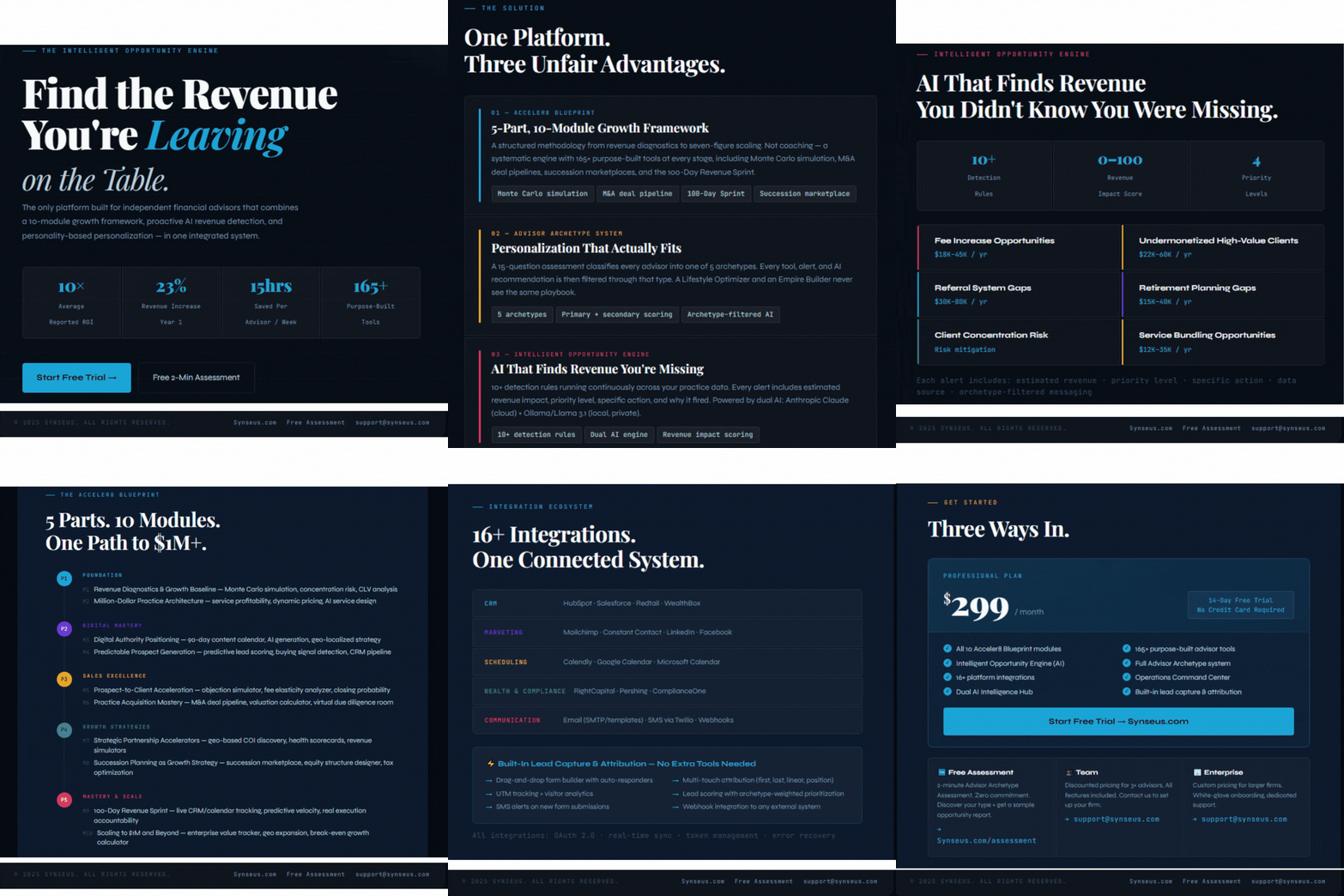
Synseus.com, Start your free trial Today!
The Competitive Advantage Window
Here’s the reality that nobody wants to acknowledge: if you’re reading this in mid-February, your window is already closing. Advisors executing this sprint right now capture available market intelligence before competitors recognize the opportunity. Tax documents are only available for 90 days. Client motivation peaks in February and declines sharply by mid-March. This is temporal asymmetry.
The practices winning this game use intelligence tools that most advisors don’t know exist. They’re not running spreadsheets and making phone calls. They’re using platforms that automate segmentation, guide conversations, and model outcomes in real time. They’re removing the friction that prevents 80% of advisors from even attempting structured tax season strategies.
By the time a typical advisor considers a “tax season initiative,” the window has shifted. Top performers are already executing. The question isn’t whether you’ll do tax season planning. The question is whether you’ll do it strategically or leave $200K to $400K on the table that your competitors just captured.
