


Do the arithmetic before you do anything else this weekend. Today is July 17. One hundred days from now is October 25. A focused growth initiative launched this coming Monday runs its full course and finishes with a week to spare before November arrives, with its holidays, its distracted prospects, its year-end service crush, and its quiet institutional agreement that nothing new starts until January.
Wait three weeks, and the same initiative limps into Thanksgiving half-finished. Wait until September, as most Financial Advisors will, and you are no longer running a 2026 initiative at all. You are drafting a 2027 New Year’s resolution with extra steps.
This is the last full sprint of the year. That fact should command your attention for most practices, the constraint on this year’s growth was never knowledge, capital, or even time. It was execution, and execution has a shelf life that expires in the fall.
The “hoarding” Problem
The typical Advisor is drowning in strategy. The binder from the practice management workshop. The notes from the podcast. The book with the folded corners. This publication, if we are being honest, lands in your inbox three times a week with frameworks. Somewhere in that accumulated material is easily six figures of unrealized revenue, and it is worth exactly nothing, because strategy without implementation is just hoarding: your brilliant plans that never generate results.
The performance cost shows up in the benchmarking data as a familiar number. In Schwab’s 2025 RIA Benchmarking Study, 59 percent of firms reported meeting or exceeding their new client growth goals, which means roughly four in ten professional advisory firms missed targets they set for themselves. We have written before about the diagnosis side of that number. Today is about the other side: even firms that diagnose correctly routinely fail to execute, because the execution vehicles they use are the wrong size.
Think about the two containers most Advisors pour their growth intentions into. The annual goal is too big. A number twelve months away exerts no pressure on any given Tuesday, which is why January’s commitment is unrecognizable by July and abandoned by October. The weekly to-do list is too small. It has no arc, no sequencing, and no memory, so growth tasks lose every scheduling collision with client service, one reasonable-sounding surrender at a time. Between the goal that is too distant to feel and the list that is too fragmented to compound, there is a missing middle, and the missing middle is where execution actually lives.
The Capacity Myth
Before the solution, clear away the most common false one: the belief that execution fails for lack of hours, and that the fix is somehow working more.
Kitces Research, which has studied advisor time use for years, finds the typical lead Advisor already works about 43 hours per week. Only about a fifth of that time is spent in actual client meetings, with roughly 15 percent going to business development and the balance consumed by preparation, analysis, service, and overhead. Read that composition carefully. Inside a standard advisory week there already exist five to seven hours pointed at growth. The same research finds that even the most productive Advisors in the profession gain only a few hours a week over their peers, through delegation and efficiency, what the Kitces team calls a game of inches rather than radical change.
So the sprint answer to “I don’t have time” is: correct, and you don’t need more of it.
You need the hours you already spend on growth to stop evaporating into unfocused motion. Five protected, concentrated, sequenced hours a week, compounded across fourteen weeks, is a transformational quantity of execution. Five scattered, interruptible, un-sequenced hours a week is what you did last quarter.
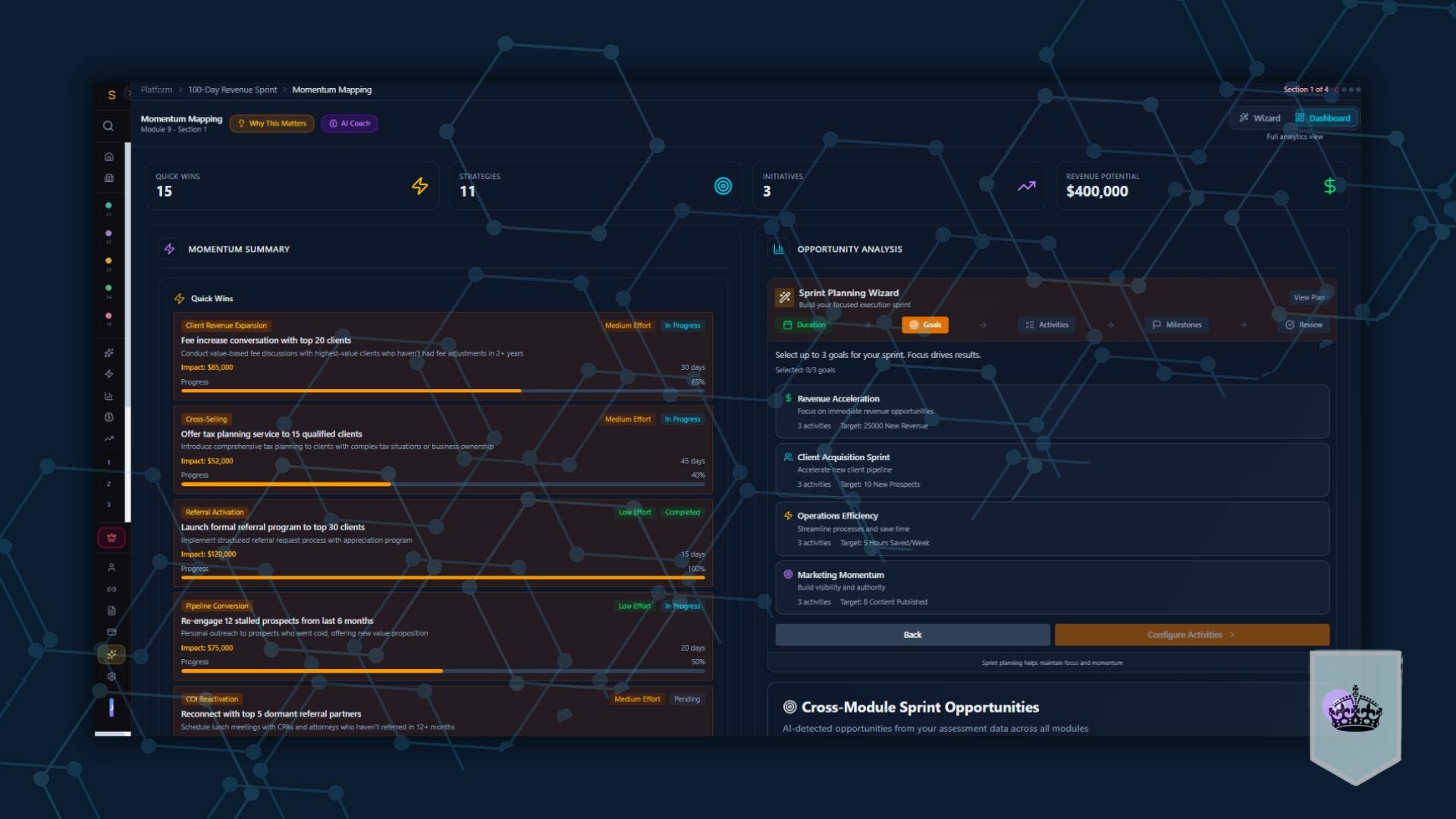
The Chairman’s Council Framework exists to close the gap between what Advisors know and what their practices actually do. Upgrade to premium membership to read the complete sprint architecture below.
What Doesn’t Fix It, and What Does
Advisors who feel the execution gap usually reach for one of three remedies. Annual strategic planning retreats produce beautiful documents and a motivational glow with a half-life of about three weeks, because they strengthen the too-big container without building the middle. Accountability coaches genuinely help, and external accountability is a real force, but a coach without an execution system becomes an expensive person you apologize to twice a month. And raw hustle, the resolve to simply push harder, fails on the arithmetic above: pushing harder on un-sequenced hours produces more motion, not more revenue.
What actually closes the gap is a container built to execution’s natural size: long enough to complete something real, short enough that every week is visibly consequential, structured enough that priorities survive contact with a busy practice. That is the entire premise of the Synseus 100-Day Revenue Sprint (Mission 9), and it is why the calendar this week matters. The framework’s operating principle is blunt: the difference between Advisors who grow incrementally and those who grow exponentially isn’t knowledge, it’s implementation velocity. One hundred days is the tested vehicle for velocity, and October 25 is the last finish line of 2026.
Below the line, the sprint in full: how to choose what deserves your hundred days, the four-phase roadmap that sequences it, the weekly operating rhythm that keeps it alive, and the measurement system that tells you in week three, not week thirteen, whether it is working.
Below the paywall: momentum mapping, the prioritization formula, the four phases with their day ranges, the rule of three, and the 60-minute weekly momentum review — become a premium member to continue.
Choose the Sprint: Momentum Mapping
A sprint fails at selection more often than at execution, and it fails in a specific way: the Advisor picks the most exciting initiative instead of the highest-velocity one.
