

Most Financial Advisors treat Q2 as the quiet stretch between tax season chaos and summer doldrums. That assumption costs them more than they realize. According to recent McKinsey research on practice performance patterns, Q2 is where elite producers create permanent separation from the pack. While average advisors are catching their breath after April 15th, top performers are running diagnostics on Q1 results and building precise revenue models for the next 90 days. This isn’t about working harder. It’s about operating from better intelligence.
Here’s the reality: if you entered April without a Q2 revenue forecast, you’re already behind. Elite Wealth Managers know exactly what their practice needs to produce this quarter, down to the number of new households required and the average account size that makes their math work. They’re not hoping for a good quarter. They’re executing against a specific model. The difference between a $400K year and a $600K year gets decided right now, in the strategic choices you make before Memorial Day.
The data from Cerulli Associates shows something fascinating about producer tiers. The advisors who consistently break through the $500K threshold don’t just work their pipeline harder in Q2. They work it differently. They enter the quarter knowing their Conservative, Target, and Stretch scenarios. They’ve mapped resource allocation against weekly acquisition targets. They’ve identified which prospects from Q1 are worth re-engaging and which partnerships are ready to activate. By the time average producers finish “getting organized,” elite producers are already three weeks into systematic execution.
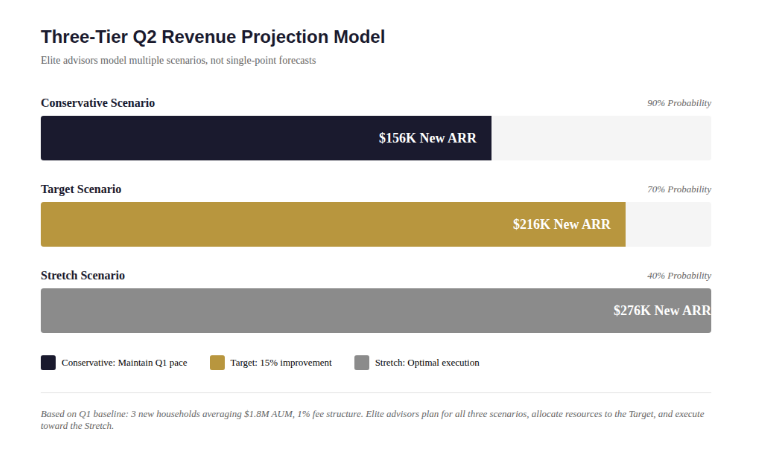
Without Q2 revenue projections, you’re flying blind. You don’t know if you’re on pace for your annual target. You can’t make intelligent decisions about marketing budget allocation. You don’t have a framework for prioritizing prospects in your pipeline. Every week that passes without a clear revenue model is a week you’re operating reactively instead of strategically. The math is brutal: advisors who skip Q2 forecasting typically miss 15 to 20 percent of available opportunities because they’re not structuring their quarter around specific acquisition targets. That’s not a rounding error. That’s the difference between hitting your number and explaining why you didn’t.
The competitive cost compounds quickly. While you’re waiting to “see how things go,” top producers have already identified exactly how many $1.5M households they need to close by June 30th. They know which weeks they’re running referral campaigns and which clients are scheduled for mid-year reviews. They’ve allocated budget to the highest ROI activities and built contingency plans for the inevitable deal that slips. Q2 is the last full quarter before summer productivity drops off. Missing this window doesn’t just hurt your Q2 numbers. It cascades through the rest of your year.
Going into April without knowing whether you’re tracking toward a $400K year or a $600K year means you can’t make intelligent resource allocation decisions. Should you invest in that strategic partnership? Depends on your pipeline velocity and close rate trends from Q1. Should you ramp up your digital positioning? Depends on whether you’re ahead of pace or need to catch up. Elite Wealth Managers run these calculations automatically. Everyone else is guessing.
While most advisors treat Q2 forecasting as “nice to have,” top producers treat it as non-negotiable intelligence. Chairman’s Council subscribers get the tactical frameworks elite advisors use to model, track, and hit revenue targets systematically, the same strategies that separate $300K practices from $600K practices. The full Q2 implementation roadmap are waiting inside.