

You’re grinding through your third consecutive 60-hour week, managing $85M in AUM at $750K in revenue, and you’ve got the math memorized: “Just need to hit $1M, then I’ll hire.” Meanwhile, Susan, who started at your firm the same month you did, just sent out a holiday card featuring her team of three. Her practice crossed $1.2M last quarter. Same market, same starting point, wildly different trajectories. The difference? She hired her first team member 18 months ago when she was at $600K and “didn’t need the help yet.”
Here’s what the data actually shows. According to Cerulli Associates, Financial Advisors and Wealth Managers who build team capacity before hitting constraint points generate 40% higher revenue growth over a three-year period compared to those who hire reactively. The gap isn’t as subtle as you might think. A solo advisor producing $750K who adds a client service associate at 75% capacity will, on average, reach $1.4M within 24 months. That same advisor who waits until they’re drowning at 100%+ capacity? They’ll still be fighting to break $1M after the same timeframe, having spent six months in hiring hell and another four months training while their pipeline went cold.
Most Wealth Advisors treat team building like an emergency room visit. You wait until you’re absolutely certain something is broken, then you show up desperate for immediate relief. Elite performers treat it like an annual physical. They monitor leading indicators, catch problems before they become crises, and invest in prevention while they still have the bandwidth to do it right.
The conventional wisdom says hire when you’re buried. The data says hire before you’re busy. There’s a massive difference between those two trigger points, and it’s costing you somewhere between $400K and $800K in unrealized revenue over the next 36 months.
The Invisible Revenue Ceiling
Capacity constraints don’t announce themselves with flashing lights and alarm bells. They show up quietly, slowly, insidiously. You stop returning calls the same day. Your prospect meetings get pushed by a week, then two. That $3M rollover opportunity from your CPA connection? You meant to follow up, but client reviews ran long, and now it’s been 11 days and the momentum is gone. The constraint isn’t that you can’t do the work. The constraint is that you’ve unconsciously started managing to your capacity instead of managing to your opportunity.
Here’s where the compounding damage really kicks in. When you’re maxed out servicing your current $500K clients, you automatically stop pursuing the $5M opportunities. Not consciously, nobody wakes up and says “I’m going to ignore the big fish today.” But your behavior shifts. You start triaging. The $800K prospect gets priority over the $3M prospect because the $800K deal is easier to close and you simply don’t have the bandwidth to run a complex six-month sales cycle while managing 90 client relationships solo.
Cerulli’s practice management data reveals that solo Financial Advisors operating above 80% time capacity spend an average of 72% of their week on activities worth $30 to $75 per hour. Client service emails, compliance paperwork, CRM updates, meeting prep, and schedule management. The $300 to $500 per hour activities that actually grow practices get squeezed into whatever’s left, which is typically 8 to 12 hours per week. You’re working 60-hour weeks while getting 12 hours of growth activity done. The math doesn’t math.
The opportunity cost is staggering when you actually quantify it. Let’s say you’re turning down or deprioritizing $8M in potential AUM annually because you’re too maxed out to run proper pursuit campaigns. At a 1% AUM fee, that’s $80K in annual recurring revenue you’re walking away from. Compounded over three years with modest growth, you’ve left $280K on the table. And that’s conservative. Most Wealth Managers operating solo at capacity are leaving closer to $15M to $20M in pursuable AUM unworked every year.
Every quarter you delay building capacity costs you 12 to 18 months of trajectory. Not because you’re doing anything wrong, but because you’re three quarters behind the Wealth Advisors who built the infrastructure to capture opportunity while you were still trying to prove you could do it all yourself.
36-month revenue impact: Hire Ahead vs. Hire When Desperate
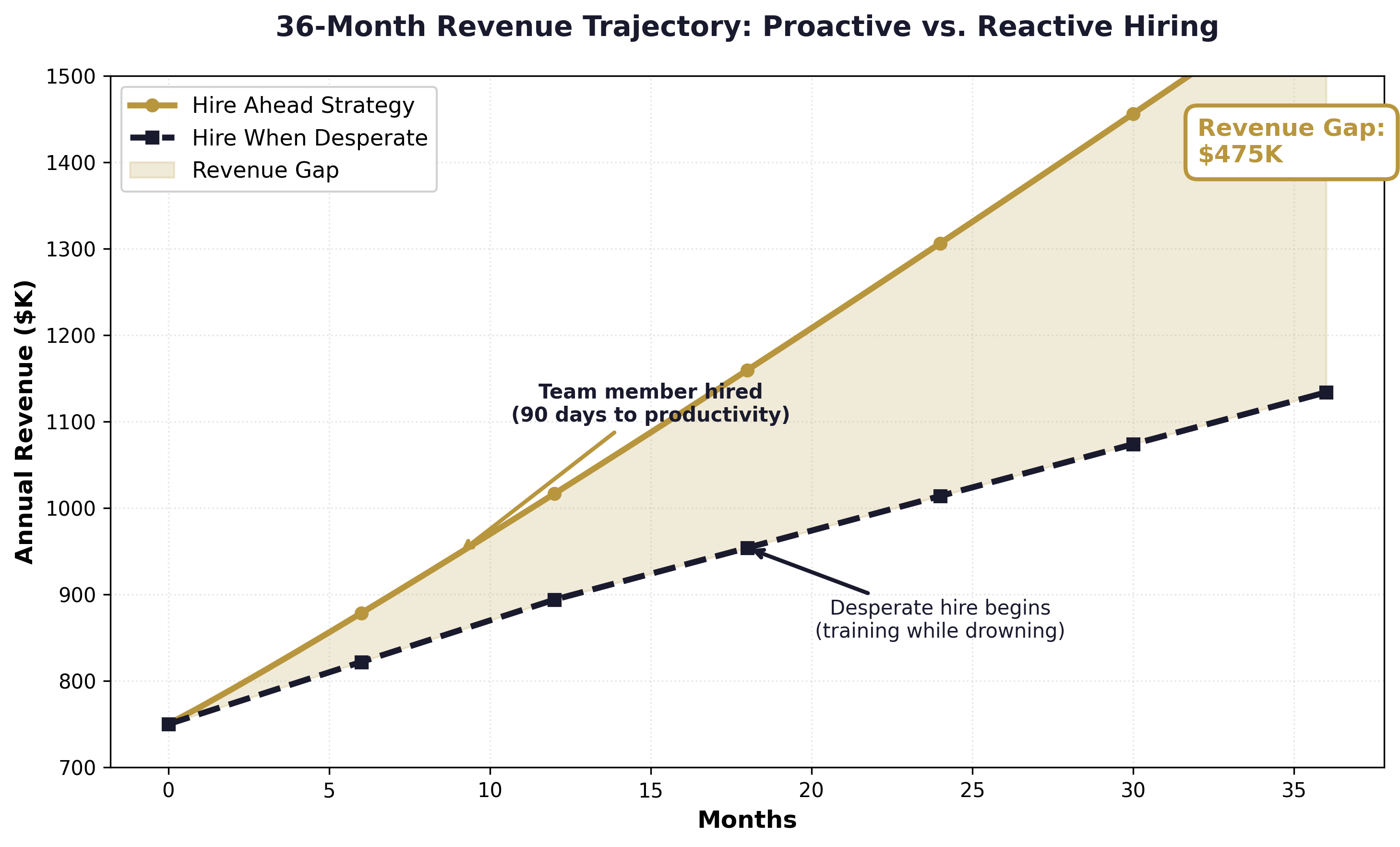
Most Financial Advisors miss the capacity signals until it’s too late. The difference between a $1M practice and a $2M practice isn’t talent, it’s timing. Elite performers monitor four specific leading indicators that tell them exactly when to hire, long before they’re drowning. Access the complete Team Building Timing Framework and Proactive Capacity Dashboard in the Synseus Advisor Tools to track these metrics in real-time and avoid leaving $400K+ on the table over the next 36 months.
Why Desperate Hiring Destroys Momentum
By the time you “need” help, you’ve already lost six to nine months of growth and momentum. Here’s how the death spiral actually unfolds. You finally hit the wall, usually around month 14 of sustained overwork. You’re snapping at clients, missing your kid’s soccer games, and your spouse is making pointed comments about whether the CFP was really worth it. You decide to hire. Great. Except now you’re trying to write a job description, screen candidates, conduct interviews, check references, and onboard someone while working 65-hour weeks and keeping 90 clients happy.
