


There is a particular kind of busy that wealth management professionals are trained to celebrate. Fully booked calendar. Back-to-back client calls. Inbox perpetually unread. The industry has spent decades equating activity with performance, and the result is a profession full of exceptionally hardworking people who cannot figure out why their revenue has plateaued.
Now according to the data, the average financial advisor spends fewer than 11 hours per week on revenue-generating activities. The remaining 30-plus hours disappear into service fulfillment, compliance administration, internal meetings, and reactive client communication. For advisors in the $200,000 to $450,000 revenue range, the group most statistically stuck, that ratio is even worse. They are running a wealth management practice the way a solo contractor runs a renovation job: head down, skilled, fully occupied, and completely unable to scale.
The advisors crossing into $600,000, $800,000, and seven figures are doing something different. Not working harder. Not working more. They have carved out a protected block of time each day where they function as the CEO of their practice rather than its most senior employee.
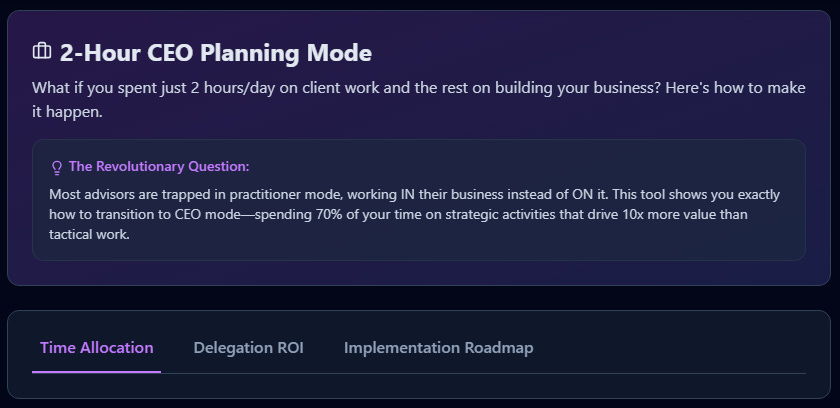
Some in the industry has begun calling it Two-Hour CEO Mode. Inside Synseus, it is becoming one of the most consistently referenced tools among high-producing users, and the results attached to it are not subtle.
What Two-Hour CEO Mode Actually Is
The concept is deceptively simple. Every business day, block an uninterrupted two-hour window and use it exclusively for the category of work that directly drives practice growth. No client service. No compliance review. No email triage. Two hours where you function as a business owner making strategic decisions, building relationships, and identifying revenue opportunities, rather than a service provider managing existing obligations.
What makes this genuinely different from generic time-blocking advice is the specificity of what goes into those two hours. This is not “focus time” or “deep work” in the productivity-blog sense. It is a structured executive operating session with defined categories of activity.
The Synseus implementation framework organizes Two-Hour CEO Mode around four revenue domains. The first is opportunity detection, reviewing your current client base for unaddressed financial events, life transitions, held-away assets, and service gaps that represent near-term revenue. The second is high-value prospect advancement, moving your top three to five open opportunities through the next concrete action in your pipeline. The third is strategic relationship development, a focused block on partnership cultivation, COI communication, and referral source nurturing. The fourth is practice architecture, the ten-minute slot reserved for evaluating what in your current operating model is capping your capacity.
Most advisors, left to their own devices, spend their entire day in reactive mode. Two-Hour CEO Mode is the mechanism that forces proactive, strategic thinking into the calendar before the calendar fills itself with everything else.
The Revenue Math Behind the Discipline
The skeptical read on this is that two hours daily is not transformative — it is simply good time management. That reaction underestimates the compounding effect of sustained strategic focus.
Consider the opportunity detection piece alone. McKinsey research on financial services client relationships consistently finds that the average affluent household maintains relationships with 2.4 financial advisors. A substantial portion of your existing clients are holding investable assets you do not manage. A structured, daily review of your book through the lens of held-away asset opportunity — the kind Synseus’s Revenue Diagnostics is built to surface, converts that passive data into active revenue conversations.
The math is straightforward. If your average client relationship represents $850,000 in AUM and your held-away identification process surfaces three viable conversations per month at a 40 percent conversion rate, you are adding roughly $1 million in AUM per month from your existing book alone. At a 1 percent advisory fee, that is $10,000 in annual recurring revenue added monthly, $120,000 in new annual revenue inside a year without a single new prospect.
That is the kind of arithmetic that only becomes visible when you have a structured, repeatable process for looking at your book strategically. Two-Hour CEO Mode is the container. Synseus is the intelligence layer that tells you where to look.
IMPLEMENT THIS WITH SYNSEUS: Revenue Diagnostics runs your current book through an opportunity detection scan that surfaces held-away assets, underserved life events, and service gaps in your existing client relationships. Most advisors who run this analysis for the first time identify between $180,000 and $400,000 in near-term revenue opportunities they were not actively pursuing. This is your Two-Hour CEO Mode fuel. Start your 14-day trial at synseus.com
Why Your Calendar Is Currently Designed to Prevent This
The reason most wealth advisors never implement anything like Two-Hour CEO Mode is not lack of discipline. It is calendar architecture. The standard practice calendar is built around client availability, not advisor leverage. Morning slots go to early risers. Afternoon slots fill with review meetings. The intervals between get consumed by follow-up and administrative overflow.
The result is a schedule optimized for client convenience and completely hostile to strategic thinking. When the day ends and nothing proactive happened, the instinct is to label it a poor time management day. In reality, it was a systems failure — the operating environment was not designed to produce strategic work.
The advisors using Two-Hour CEO Mode effectively treat that block the way they treat client appointments: non-negotiable, calendared weeks in advance, protected from internal requests and same-day scheduling. The block does not move because a wholesaler wants a morning call. It does not compress because a client review ran long. It holds.
That cultural rigidity, more than any specific task inside the block, is what makes this work. The message it sends to your team, your calendar, and frankly your own behavioral patterns is that this practice has a CEO function — and the CEO shows up every day.
IMPLEMENT THIS WITH SYNSEUS: The 100-Day Revenue Sprint includes a calendar redesign framework specifically engineered for wealth management practices — mapping your Two-Hour CEO Mode blocks, your business development activities, and your client service obligations into a weekly template that protects strategic time without compromising client experience. It is the operating system your calendar currently lacks. Start your 14-day trial at synseus.com
The Four-Domain Breakdown: What Actually Happens Inside the Block
Understanding the principle is one thing. Knowing precisely what to do when you sit down for those two hours is where most advisors stall. The Synseus Two-Hour CEO Mode framework is structured as four sequential segments, each with a defined output.
